- Tags:
- Curiosities
The history of brownies from early recipes to the next slice
Brownies are the sort of bake that rarely needs introducing.
Brownies are the sort of bake that rarely needs introducing. Someone opens a box, the chocolate smell catches your attention, and suddenly finding a plate seems quite urgent. Their history, however, is less straightforward than their popularity.
Brownies originated in the United States in the late nineteenth century, with early recipes developing into the chocolate traybake we recognise today. Chicago's Palmer House Hotel is closely associated with their beginnings, although naming one undisputed inventor is more difficult. Like many favourite foods, brownies have collected a few good stories along the way.
Where did brownies come from
According to Palmer House's own history, a brownie was created in its kitchen at Bertha Palmer's direction for the 1893 World's Columbian Exposition in Chicago. The hotel still serves a version of the recipe it identifies with that event.
Its brownie has walnuts and an apricot glaze, a combination that might surprise anyone expecting a plain chocolate square. It is a useful reminder that there has always been more than one way to make a brownie. The familiar chocolate base leaves room for different toppings and textures, even in one of its earliest origin stories.
The Palmer House account is an important part of brownie history, but food history does not always offer a tidy first bake, first name and first published recipe. Those milestones can happen at different times, which is why claims about the very first brownie deserve a little care.
A brownie recipe without chocolate
There is another detail worth clearing up. Fannie Merritt Farmer's 1896 edition of The Boston Cooking-School Cook Book included a recipe called Brownies, but it was made with molasses and pecans. There was no chocolate in the ingredient list.
Those little bakes were prepared in shallow cake tins. They share the name, but they are a different proposition from the chocolate brownies most of us picture now. Chocolate brownie recipes were being published in the early twentieth century; Farmer's 1906 edition included a chocolate version. The brownie was taking on its more familiar form.
You may also have heard the story of a cook who forgot the raising agent in a chocolate cake and accidentally made brownies. It is an appealing kitchen mishap, but it is best treated as a story rather than a proven explanation. A tray of good brownies does not need an accident to justify its existence.
Fudgy cakey or somewhere in between
Once brownies became established, bakers had plenty of room to make them their own. Some are dense and fudgy, some have a lighter, more cake-like crumb, and others offer a chewy middle with a delicate crust on top.
These differences come from the balance of ingredients and the baking method. Changes to the proportions of fat, sugar, chocolate and flour can alter the finished texture, as can mixing and baking time. A fudgy brownie is a deliberately rich bake; its soft centre does not automatically mean it is underbaked.
There is room for strong opinions here. Some people will always choose the corner piece, while others quietly work their way towards the middle of the tray. At Sponge, we lean towards a proper chocolatey, fudgy treat, with enough substance to make a small piece worth lingering over.
The variations that keep things interesting
Chocolate chunks, nuts, fruit and caramel all offer different ways to build on the original idea. A little salt can balance a sweet caramel layer, while fruit brings sharpness alongside the richness of chocolate.
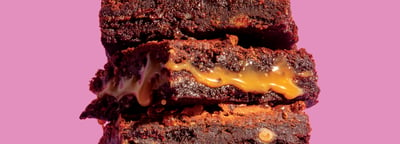
Our Triple Chocolate Brownie Box is a good starting point for someone who wants plenty of chocolate. The Salted Caramel Brownie Box takes things in a sweeter, lightly salty direction. Explore the brownie range to find the current flavours and combinations.
Blondies are part of the wider traybake family too. They usually leave out the cocoa-rich base, drawing more of their character from flavours such as brown sugar and vanilla. Adding white chocolate to a dark brownie, however, still leaves you with a chocolate brownie.
A familiar treat with plenty of life left in it
Today, brownies can be an afternoon pick-me-up, a birthday gift or the pudding you bring out with ice cream. Our gluten-free brownies and vegan brownies offer more ways to enjoy that rich chocolate flavour; check each product's ingredients when choosing for a particular diet.
From nineteenth-century American kitchens to a box arriving at your door, the brownie has proved wonderfully adaptable. The history is interesting. Choosing your next piece is rather enjoyable too.