- Tags:
- Curiosities
From Tea Taster to Tea Trailblazer: The Story Behind Spill Tea
Louise Cheadle spills the tea.
There is something wonderfully reassuring about a proper cup of tea.
It’s a ritual, a comfort, pause, catch-up, cure-all. It is what we make when someone arrives, when the news is bad, when the cake comes out, when the day has run away with us. We drink a lot of it in Britain, but how often do we really stop to think about what is in the cup?
That question sits at the heart of Spill Tea, the business founded by Louise Cheadle and Sofia, her long-time business partner and fellow tea expert. And after speaking to Louise, it quickly becomes clear that this is not just another tea brand with pretty packaging and good intentions. It is the result of years spent inside the industry, asking difficult questions and deciding, eventually, to do something about them.
Louise knows tea inside out. Before Spill Tea, she spent 16 years at Teapigs, which she co-founded, and before that, worked as a tea taster for Tetley, travelling the world and tasting tea at source. It is the kind of career that sounds glamorous from the outside, but what it gave her was something even more valuable: a deep understanding of how tea should taste, how it is grown, and where the industry too often falls short.
Over time, two frustrations began to grow. The first was quality. From a UK perspective, Louise felt the quality of tea had slipped. We are a nation of tea drinkers, and yet, somehow, many of us are no longer drinking the best tea we could be. The second issue ran deeper still: the supply chain itself. Too much of the money, she explained, gets lost among middlemen and brokers, and not enough reaches the farmers at origin. In a world where around 70% of tea is grown by smallholder farmers, that matters.
So Louise and Sofia left Teapigs together, after 16 years working side by side, with a simple but powerful mission: how can we make tea taste better, and how can we make sure the farmer is paid fairly?
Spill Tea is their answer.
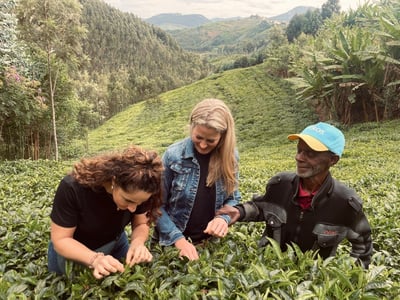
The tea comes from Rwanda, where the growing conditions are close to ideal: volcanic soil, rolling hills, a balance of sunshine and rain. But what is especially interesting is how structured and quality-led the system is there. Farmers are incentivised to pick to a high standard; “two leaves and a bud” from the first shoots being the gold standard, and if their tea meets that quality, they receive an additional payment. There is also a digital payment system in place, so once tea is checked at the collection point, farmers are paid quickly and directly. The foundations, Louise says, are strong, and that consistency shows up in the cup.
Of course, building a business around that vision has not been without its challenges. Getting tea from Rwanda to the UK is not always straightforward, and Louise is refreshingly honest about the reality of that. There have been delays, packing challenges and logistical knots to untangle, particularly in the early days when parts of the packing process were based in Poland before moving to the UK.
But Louise speaks about these hurdles with the kind of calm perspective that comes from experience. When you have built before, she says, the setbacks feel less like disasters and more like steps on the journey. That is not to say the doubts disappear. In fact, 18 months in, she admits there is still at least one moment a week when she and Sophia wonder whether it will all work out.
And yet the optimism remains. Because the fundamentals are there. They work with brilliant farmers. They know the tea is good. The reviews are strong. The real challenge now is getting more people to try it.
That belief in the product is perhaps what makes the customer moments so moving. Spill Tea still packs individual online orders themselves, apart from larger retail orders such as Waitrose, so they remain close to every part of the process. That includes reading every single review. Louise says it still catches them by surprise when customers take the time to say how much they love it. One review, in particular, has stayed with her: “this tea has changed my life.”
That kind of response is hard to fake.
There is also something lovely in the way Spill Tea invites customers into the story. Postcards are included in orders so people can write directly to the farmers and say thank you. Louise and Sophia were not sure whether anyone would actually do it. But they did. When the pair visit the farm in Rwanda, which they do roughly every six months, they take a stack of those messages with them. It is a small gesture, perhaps, but a deeply human one.
That same closeness runs through the brand in other ways too. Early focus groups were made up of friends and family. Today, subscribers have become an ongoing sounding board, a kind of loyal tea-loving focus group helping shape decisions on everything from bag shapes to future blends. Samples, trial packs and referral discounts all play their part in gently nudging the brand forward, one cup at a time.
And there is plenty more to come. Louise would love to expand the range, using the existing tea base as a starting point for new blends such as Earl Grey with bergamot, and perhaps green tea too, sourced from a neighbouring farm already producing it.
At its core, Spill Tea is about doing things better: better taste, better sourcing, better packaging, better payments. The tea bags are compostable, the paper packaging is recyclable at home, and the brand avoids unnecessary layers of plastic and foil. But perhaps more importantly, the ethics are built into the business model, not added on afterwards.
In a country where coffee has now overtaken tea as the UK’s most consumed drink, Louise is quietly determined to remind us what a really good cup of tea can be.
And if you are wondering what to serve alongside it? Louise is a carrot cake fan. Honestly, that feels like exactly the right place to start.